Representing the Holocaust: History, Theory, Trauma by Dominick LaCapra
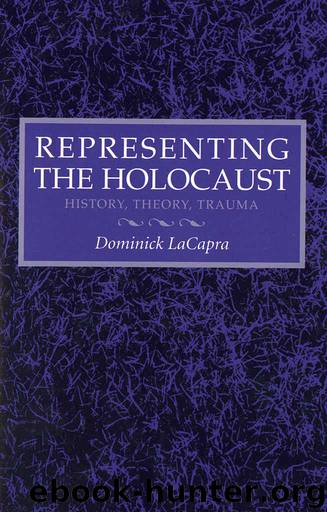
Author:Dominick LaCapra [LaCapra, Dominick]
Language: eng
Format: azw3
Publisher: Cornell University Press
Published: 2016-05-01T16:00:00+00:00
One may agree with the view that de Man’s later work in some sense implicitly inscribes historicity and the Holocaust and yet take issue with Felman’s reading of the manner and relative adequacy with which this inscription takes place. But even if one fully agrees with Felman about the nature of the silent inscription of historicity and the Holocaust in de Man’s later texts, one may yet argue that this procedure is not sufficient to explain the absence of an explicit attempt to come to terms with the early articles. (One may also object to a reduction of alternatives to an extreme binary opposition between silence and a finalized, “totalizing overview” [P.720]). A conception of the workings of the later texts in terms of silent traces, mute omnipresences, and allegorical allusions is too general to account for a specific lack, notably when the conception is prompted by a manifest desire to justify that lack. Indeed, if de Man believed that silence was the only acceptable response to the Holocaust or his own relation to it, he might at the very least have said as much, however paradoxical or aporetic the gesture would have been. The idea that “the war’s disastrous historical and political effects are what is implicitly at stake in the text’s insistent focus on, and tracking of, an ever-lurking blindness it underscores as the primary human (and historical) condition ”lends itself to the interpretation Felman ostensibly attempts to counter: the view that de Man evasively essentialized a problem he was unwilling or unable to confront in specific terms.
Although she contends that de Man’s silence said all that can or need be said, Felman nonetheless engages in an extremely speculative form of contextualizing ascription by filling in de Man’s silences with views explicitly elaborated by others, be they contemporary figures (such as Michel Leiris) or an author such as Melville. In one of the most dubious instances of this tendency, with reference to a review by de Man that appeared in Le Soir on 1 September 1942, titled “‘Le Massacre des Innocents’—poéme de Hubert Dubois,” she comments: “The poem de Man chose to review, written by a Belgian author, is a barely masked allegory of the Nazi extermination of the Jews” (p. 714). Felman does not observe that this construction of the poem is her own and is not mentioned by de Man, who in fact provides an extremely formal, overly generalized, and essentializing analysis. De Man writes in this review that the poem “unite[s] . . . the laws of truth with those of poetry”and shows that “suffering is salutary because it enables one to expiate repeated crimes against the human person.”8 Felman herself quotes another essentializing and vague comment de Man makes without exploring its relation to her exegesis: “One could easily call ‘The Massacre of the Innocents’ a meditation on the guilt which has led humanity to the awful state in which it is plunged at the present moment” (p. 715). From de Man’s statements it
Download
This site does not store any files on its server. We only index and link to content provided by other sites. Please contact the content providers to delete copyright contents if any and email us, we'll remove relevant links or contents immediately.
| Africa | Americas |
| Arctic & Antarctica | Asia |
| Australia & Oceania | Europe |
| Middle East | Russia |
| United States | World |
| Ancient Civilizations | Military |
| Historical Study & Educational Resources |
Cecilia; Or, Memoirs of an Heiress — Volume 1 by Fanny Burney(32559)
Cecilia; Or, Memoirs of an Heiress — Volume 2 by Fanny Burney(31957)
Cecilia; Or, Memoirs of an Heiress — Volume 3 by Fanny Burney(31943)
The Secret History by Donna Tartt(19097)
Sapiens: A Brief History of Humankind by Yuval Noah Harari(14392)
Leonardo da Vinci by Walter Isaacson(13338)
The Radium Girls by Kate Moore(12033)
Sapiens by Yuval Noah Harari(5374)
How Democracies Die by Steven Levitsky & Daniel Ziblatt(5221)
The Wind in My Hair by Masih Alinejad(5097)
Homo Deus: A Brief History of Tomorrow by Yuval Noah Harari(4921)
Endurance: Shackleton's Incredible Voyage by Alfred Lansing(4785)
Man's Search for Meaning by Viktor Frankl(4608)
The Silk Roads by Peter Frankopan(4537)
Millionaire: The Philanderer, Gambler, and Duelist Who Invented Modern Finance by Janet Gleeson(4481)
The Rape of Nanking by Iris Chang(4217)
Joan of Arc by Mary Gordon(4116)
The Motorcycle Diaries by Ernesto Che Guevara(4105)
Stalin by Stephen Kotkin(3970)
